Airline rules last checked: November 4, 2026, on each airline's official page. By the Rockair team.
Quick answer: Before you book, check the length limit, because a longboard can be too long for some planes. Then get a travel bag long enough for the board and its protection, take out the fins, protect the nose and tail first, and fill the empty space so the board can't slide. The basics are the same as any board. The length is what changes everything.
This guide only covers what's different with a longboard. For the full packing steps, see how to pack a surfboard for a flight.
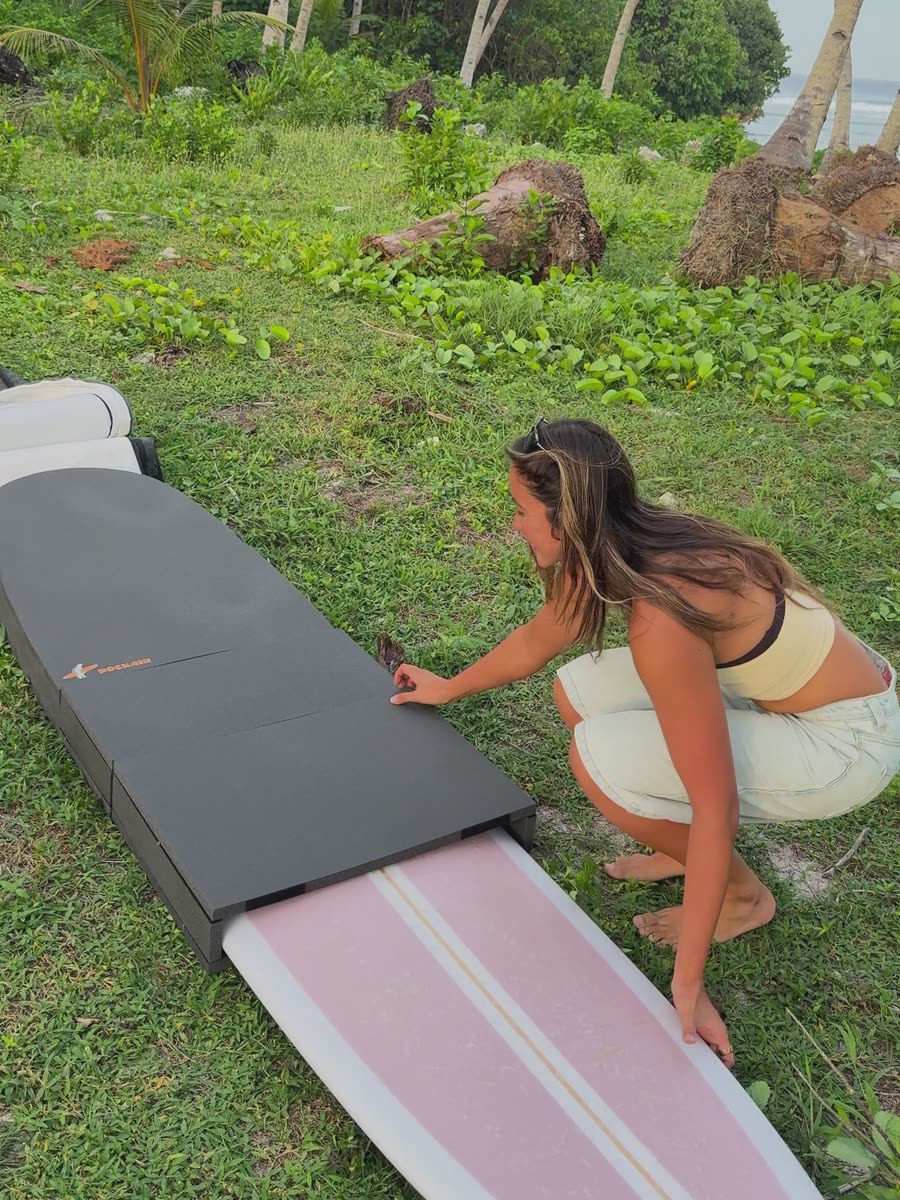
Step 1: Check the length limit before you book
With a shortboard you rarely think about this. With a longboard it can decide which flight you take.
| Airline | Length limit | What it means for a longboard |
|---|---|---|
| Alaska and Hawaiian | 10'5" for the bag, nose to tail. On the E175, the announcement says 9'7" and the contract says 115 linear inches, 8 feet max on any side | The most room on this list. Check which plane you're on |
| United | 115 inches long on United's sports page, but 115 linear inches (length + width + height) in its Contract of Carriage. United Express: 92 inches long vs. 80 linear inches | The two pages don't match, and on the contract's numbers a longboard bag is over the limit. Ask United before you book |
| Delta | 115 linear inches for the bag: length + width + height (72 inches for boards on Delta Connection) | Do the math below |
| JetBlue | No length limit in the surfboard rules we read. Up to 99 lb and one board per bag | Call and ask before you book |
| Southwest | No length limit in the surfboard rules we read. Up to 100 lb | Call and ask before you book |
Checked on the airlines' official pages on November 4, 2026. Rules change, so check again before you fly. For fees, see surfboard fees by airline.
The Delta math. Delta adds length, width and height together. A 9' board is already 108 inches long. Add the width and thickness of the bag and you're well past 115 inches. On paper, a longboard bag doesn't fit that limit. Delta's page doesn't say how they measure in practice, so talk to Delta before you buy the ticket.
Check every leg. Your long flight might be fine and the short connection might not. United Express and Delta Connection have much shorter limits than the main airline.
United outside California. United's sports page waives the oversize fee on flights to and from California, for up to 2 board bags. The Contract of Carriage doesn't mention this. Anywhere else, including connections through California, a board bag over 62 inches pays the oversize fee. Every longboard bag is over 62 inches, so count that in your price.
Measure the bag, not only the board. The bag is longer than the board inside it. If you're close to a limit, measure the packed bag from end to end and ask the airline which number they go by.
Step 2: Get a bag that's really long enough
- Check the inside length. The size on the label doesn't always tell you how much room you get. Look for the inside length, and leave room for whatever you put on the nose and tail. A full foam shell adds to the size of your board, see Step 4.
- Check the width too. Longboards are wide. Your board has to go in without the zipper pulling on the rails.
- Think about wheels. A long bag is awkward to carry on your own, and wheels make the airport much easier.
- Try it at home. Pack the board with all its protection and close the zipper before the day of your flight. If you have to force the zipper, the bag is too tight.
Step 3: Take out the fins
The steps are the same as on any board, and the packing guide covers them. On a longboard that usually means a big center fin, plus side fins if you have them. Keep the screw and plate with the fin in a small bag, because they're easy to lose and you'll need them when you land.
Step 4: Protect the nose and tail first
The nose and tail sit at the very ends of a long bag. Those ends are easy to knock when the bag gets turned or set down. Protect them before anything else, then cover the rails.
You have two ways to do it:
DIY padding. Foam pipe insulation on the rails, extra layers or a folded towel on the nose and tail. It's cheap, but there's a lot more rail to cover on a longboard, so it takes longer to cut and tape. You may have to redo it for the flight home.
A full foam shell. The Rockair Long Shell covers the whole board from nose to tail. It's closed cell foam, about 3/4 inch (20 mm) thick on every side. It comes in two parts and goes on in about 10 seconds, plus a few seconds for each extension, then the board and shell slide into your own bag. With extensions it fits boards up to 9'11" long and 24" wide. The shell adds about 1.6 inches (40 mm) to your board's length and width, and it's about 4.3 inches (11 cm) thick on the outside. The foam compresses, so a thicker longboard still fits. Extensions matter on this size, so use Find my size to get the right setup. It also works in a bag with 2 longboards, if your airline allows it. The Long Shell is currently on pre-order. We've flown with it ourselves. It reduces the risk of damage. No product makes a surfboard unbreakable.
Worth knowing: a shell that fits a 9'11" board doesn't change the airline's limit. A 9'11" board is still over United's 115 inches.
Step 5: Stop the board from sliding
A long board in a long bag has more room to shift. Fill the gaps along the whole length with towels, a wetsuit or clothes, not just at the ends. Keep hard things away from the deck, and don't over tighten the straps. Then weigh the bag at home, because many airlines charge extra above 50 lb.
Step 6: Getting it through the airport
- Carry it from the middle, with the nose forward, so you can see where the front end is going.
- Slow down at corners, doors and elevators. That's where the ends of a long bag hit things. Ask someone to take the other end if you can.
- Allow extra time. A long bag is harder to move through a crowded airport and can be awkward to fit in a shuttle or taxi, so plan your ride ahead.
- Check it before you leave the airport. Open the bag and look over the nose, tail and rails. More on this in how to fly with a surfboard.
FAQ
Can you fly with a 9 foot surfboard?
Yes, on some airlines, but check your exact route. Alaska and Hawaiian allow a bag up to 10'5" nose to tail (on the E175, their announcement says 9'7" and their contract says 8 feet max, so ask first). United's own pages disagree on how it measures, so ask first. Delta counts the bag's length, width and height together, so ask them first too. Rules checked November 4, 2026.
What is the longest surfboard you can take on a plane?
Among the airlines we checked, Alaska and Hawaiian state the longest limit: a bag up to 10'5" nose to tail, so the board inside has to be shorter than that. JetBlue and Southwest don't give a length in the surfboard rules we read.
Do you need a special bag for a longboard?
You need a travel bag made for that length, with room for the board and its protection. A short bag puts pressure on the nose, tail and zipper.
Can you take a longboard on a small regional plane?
Often not. United Express has a limit of 92 or 80 inches, depending on which United page you read, and Delta Connection doesn't take boards over 72 inches. Check every leg of your trip.
Does Rockair make a shell for longboards?
Yes. The Long Shell fits boards up to 9'11" long and 24" wide with extensions, and it's currently on pre-order. Find my size shows the setup for your board.
More guides
- How to pack a surfboard for a flight
- Surfboard fees by airline
- How to fly with a surfboard without damage
- All surfboard travel guides
Sources: official airline pages, checked November 4, 2026: United Contract of Carriage, Alaska and Hawaiian announcement, Alaska and Hawaiian Contract of Carriage, Delta, JetBlue, Southwest, United.