Checked by Rockair on November 1, 2026. Airline rules change, so confirm with your airline before you fly.
Flying with your own board is the best part of a surf trip, until you open the bag at baggage claim. The nose, the tail, the rails and the fins need the most care. The right bag, the right padding and a few minutes of preparation lower the risk.
This guide covers everything, from packing at home to what to do if something goes wrong.
1. Check your airline's rules before you book
Every airline treats surfboards differently. Some count a board bag as a regular checked bag, some charge a sports equipment fee, and some have length or weight limits.
Before you book:
- Find your airline's "sports equipment" or "surfboards" page.
- Check the maximum length and weight for a board bag.
- Check the fee, one way and return. It can change the cheapest flight.
- If you have a connection on a different airline, check that airline too.
2. Choose a travel board bag, not a day bag
A day bag is thin and made to keep the sun off your board. For a flight you need a travel bag with thicker padding, a strong zipper and room for extra protection.
What to look for:
- Thick padding along the full length of the bag.
- A bag that is long enough for your board plus some extra space at the nose and tail.
- Handles and a shoulder strap, or wheels if you are flying with more than one board.
3. Protect the nose, tail and rails
These are the parts of the board to protect first.
The old way is to wrap the board in bubble wrap, pipe insulation or towels. It works, but it takes time, it moves around in transit, and you have to do it again for the flight home.
The faster way is a full-length foam shell that wraps the board from nose to tail. A Rockair shell is made of closed cell foam, about 3/4 inch (20 mm) thick on every side, and is shaped to the outline of the board. You put it on your board, slide both into your board bag, and check in as usual. It stays in place, and you use it again on the next trip.
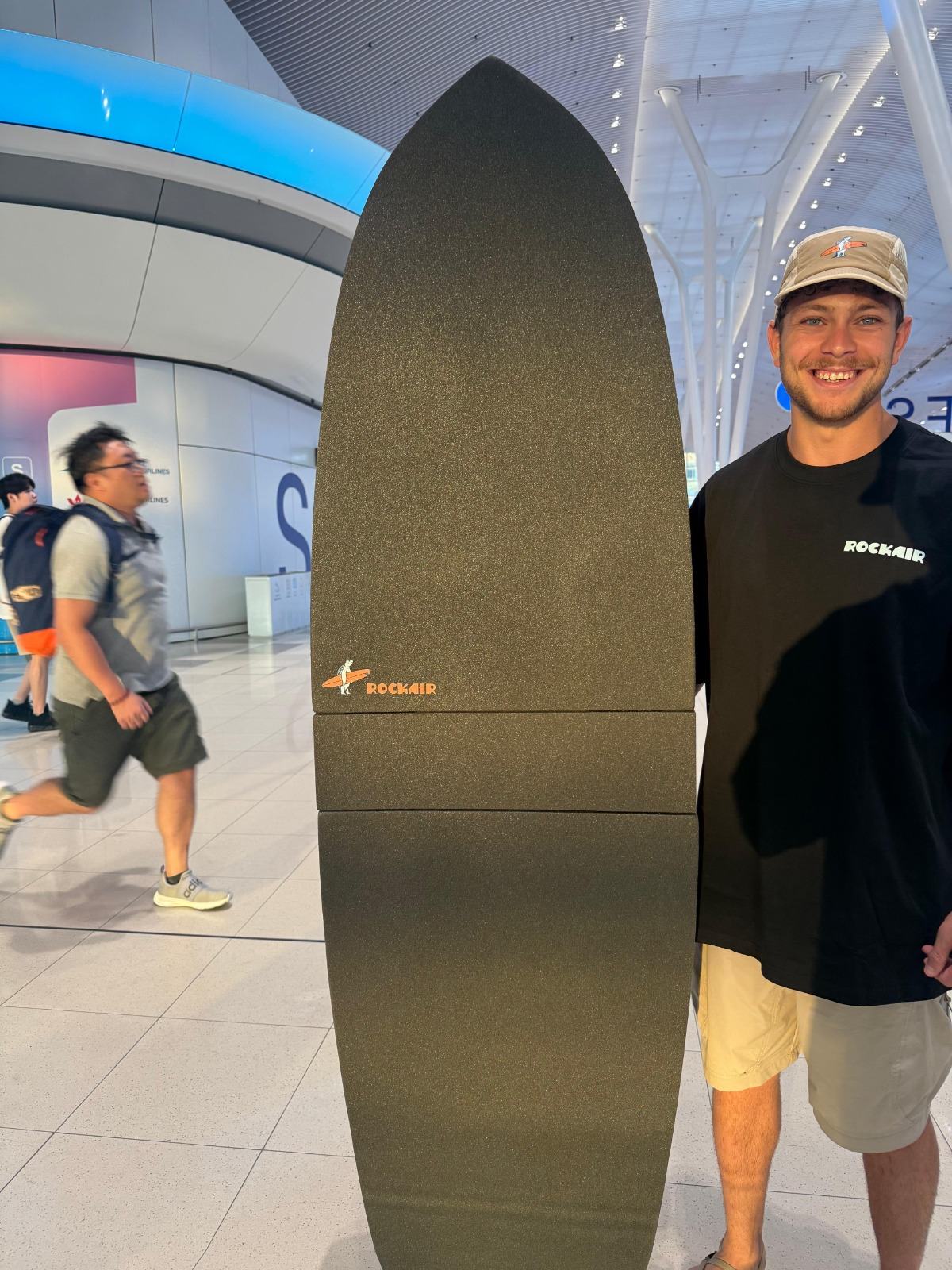
Which Rockair fits your board?
- Rockair Short Shellboards up to 7'5" long and 19.5" wide
- Rockair Hybrid Shellboards up to 7'11" long and 22" wide
- Rockair Long Shellboards up to 9'11" long and 24" wide
These lengths include extensions. Find my size shows the exact setup for your board and the total price.
Find my size4. Remove the fins
A fin under pressure can crack the fin box. Remove them, put them in a small bag, and pack them in the middle of the board bag or in your suitcase.
5. Pack smart around the board
- Use clothes and towels to fill empty space so the board does not slide inside the bag.
- Do not pack heavy or hard items (like a fin key, wax comb or bottles) directly against the deck. They cause pressure dings.
- Do not over tighten straps over the board. Tight straps can press into the rails.
- If you fly with two boards, put a layer of protection between them.
How to pack a surfboard for a flight, step by step
6. At the airport
- Take photos of your board before you leave home and of the bag at check in. If there is damage, you will need them.
- Label the bag with your name, phone and email, inside and outside.
- Ask for a fragile sticker. It does not guarantee careful handling, but it does not hurt.
- Read before you sign. Some airlines ask you to sign a limited release form for fragile items. This can limit what they pay if the board is damaged. Ask what it covers before you sign.
- Arrive early.
7. When you land
- Open the bag and check the board before you leave the airport.
- If there is damage, report it at the airline's baggage desk right away and get a written report with a reference number.
- Keep your boarding pass, bag tag and photos.
- Airlines have time limits for damage claims, and some are only a few hours. Check your airline's rules.
Quick checklist
- Airline rules and fees checked
- Travel board bag with thick padding
- Nose, tail and rails protected (foam shell or padding)
- Fins removed and packed
- Empty space filled, no hard items against the deck
- Photos taken, bag labeled
- Board checked before leaving the arrival airport
FAQ
What is the best way to pack a surfboard for a flight?
Remove the fins, protect the nose, tail and rails with a full-length foam shell or padding, put the board in a padded travel bag, and fill the empty space so it cannot move.
Can you take a surfboard on a plane?
Yes. Most major airlines accept surfboards as checked baggage. Rules and size limits are different for each airline, so check before you book.
How much does it cost to fly with a surfboard?
It depends on the airline and the route. Some airlines charge their normal checked bag fee, and others charge a sports equipment fee.
How do I protect the rails of my surfboard when traveling?
A shell that covers the full length of the board protects the rails as well as the nose and tail. Padding inside the bag along the rails also helps.
Do I still need a board bag if I use a Rockair shell?
Yes. A Rockair shell goes on the board, and then the board goes into your board bag. The two work together.